

-
Content
Last Updated on September 11, 2024 by Robert Luong
Have you ever tapped your credit card to pay for your morning coffee and wondered what really happens behind the scenes?
Credit card processing may seem like magic, but there's a lot more going on behind the scenes. In 2024, credit cards make up 22% of online transactions and 39% of in-person purchases, so they’re a big part of how we shop today. It’s a complex system that keeps modern commerce running smoothly and allows businesses to get paid instantly, from anywhere in the world.
So, what exactly is happening in those few seconds? Let’s break down the key players and what makes credit card processing such a powerful network for businesses.
The ultimate guide to accepting credit cards.
Discover essential knowledge and industry insights to increase your bottom line.
Who are the key players in credit card processing?
When it comes to credit card processing, it might seem like magic happens the moment customers swipe or tap their card. But behind the scenes, there are several key players making this process smooth and secure. Let’s break down who’s involved.
1. Credit cardholders
Credit cardholders are your customers, who use their credit or debit cards to buy your products or services. They initiate the payment, and from there, credit card processing starts behind the scenes.
2. Merchant
As a merchant, your role is to make sure your point-of-sale (POS) system is set up to handle card transactions smoothly, whether it’s in-store or online.
3. The card network
Visa, MasterCard, American Express, and Discover are the card networks that facilitate communication between your bank and your customer's bank.
4. The acquiring bank
When a customer makes a payment, the acquiring bank works with the credit card processing companies and card networks to authorize and process the transaction. They ensure the funds are securely transferred from your customer's bank to your business account.
5. The issuing bank
The issuing bank is the customer’s bank that issued the credit or debit card. They’re the ones that approve or decline the transaction based on the cardholder’s account credit balance.
6. The credit card processor
The credit card processor (also known as a credit card processing company) works with the card networks and issuing banks to authorize, authenticate, and settle credit card transactions. Companies like Helcim, Stripe, and Square are examples of credit card processors.
How does credit card processing work?
Credit card processing might seem like a simple swipe, tap, or click, but behind the scenes, it's a complex and highly coordinated process.
The entire process happens in real-time, often in less than a second. For example, Visa processes 24,000 transactions every second. This allows merchants worldwide to receive instant approval for purchases.
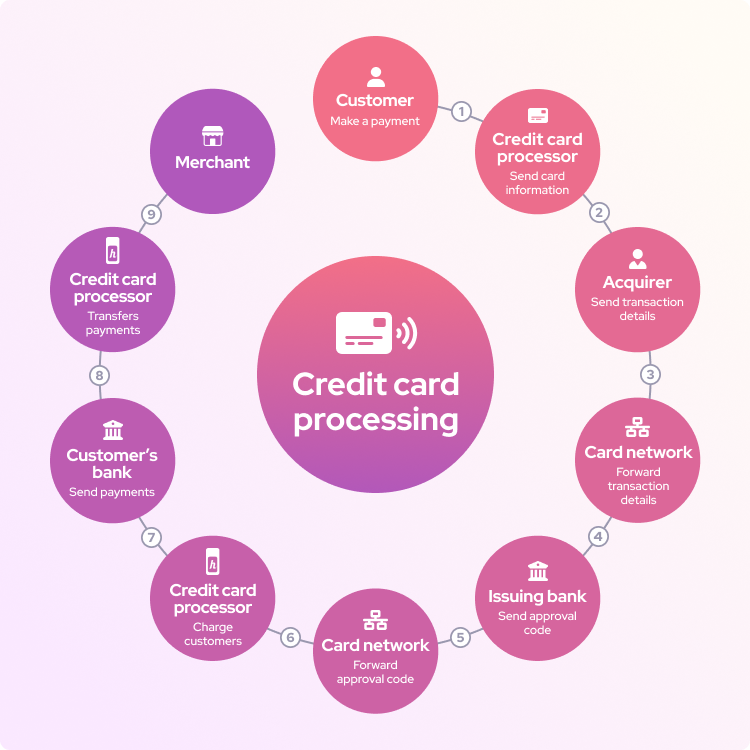
The credit card processing flow is broken down into three key stages: authorization, authentication, and settlement.
1. Authorization
The process begins when a customer uses their credit card to make a purchase by tapping, inserting, or swiping it at your credit card machine. For online purchases, they enter their card details at the checkout page.
The payment terminal sends the transaction details (like card number, cardholder name, and purchase amount) to your credit card processor. The credit card processor then sends transaction requests to the card network.
2. Authentication
Once the card network receives the transaction request, it identifies the issuing bank (e.g., Citi Bank) and forwards the transaction details to that bank.
The issuing bank verifies the card’s validity, checks for any fraud flags, and confirms if the cardholder has enough available credit.
If everything checks out, the issuing bank will send the approval code through the card network to the credit card processor, confirming that the transaction is legitimate and funds are available.
The payment processor then sends a message to your payment terminal or payment gateway, displaying the approval message. At this point, the customer’s purchase is approved, and they can complete the transaction.
3. Settlement
At the end of each day, the card network transfers funds from the cardholder’s bank to the payment processor. From there, the funds are transferred into your business account, completing the transaction cycle.
Why is there a fee for processing credit cards?
Credit card processing fees exist because every player in the credit card transaction chain benefits from facilitating these payments, and each takes a small share to cover their services and risks.
-
Issuing banks: Issuing banks charge interchange fees that compensate them for the risk of loaning money to cardholders and handling potential fraud.
-
Acquiring banks and processors: Acquiring banks and payment processors a cut of each transaction as compensation for processing payments, handling customer support, and ensuring security.
-
Card networks: Visa, MasterCard, and other card networks charge a fee to cover their operating costs and the risk of a fraudulent transaction. These fees also pay for credit card users’ benefits, such as cashback, points, or travel miles.
How much are credit card processing fees?
The credit card processing fees are ranging from 1.7% - 3.5%, depending on the credit card processors.
Top processors with the lowest credit card processing fees for Canadian businesses:
| Payment companies | Online fees | In-person fees |
|---|---|---|
| Helcim (interchange-plus) | 2.39% (avg) + $0.25 | 1.76% (avg) + $0.08 |
| Moneris (flat-rate) | 2.85% + $0.30 | 2.65% + $0.10 |
| Square (flat-rate) | From 2.90% + $0.30 to 3.3% + $0.15 | 2.5% |
| Stripe (flat-rate) | 2.90% + $0.30 + 0.5% for manually entered cards + 0.8% for international cards* + 2% if currency conversion is required | 2.7% + $0.05 |
| Clover (flat-rate) | 3.50% + $0.10 | 2.30% + $0.10 |
Top processors with the credit card processing fees for U.S. businesses:
| Payment companies | Online fees | In-person fees |
|---|---|---|
| Helcim (interchange-plus) | 2.49% (avg) + $0.25 | 1.93% (avg) + $0.08 |
| Moneris (flat-rate) | 2.85% + $0.30 | 2.65% + $0.10 |
| Square (flat-rate) | From 2.90% to 3.30% + $0.30 | 2.60% + $0.15 |
| Stripe (flat-rate) | From 2.90% + $0.30 + 0.5% for manually entered cards + 1.5% for international cards + 1% if currency conversion is required | 2.70% + $0.50 |
| Clover (flat-rate) | 3.50% + $0.10 | 2.30% + $0.10 |

The credit card processing fees are made of two primary components: interchange fees and processor margin.
1. Credit card interchange fees
The interchange fee is a variable cost that includes both the interchange fees and the card-network fees. This fee is paid to your customer's issuing bank. How much you end up paying can vary based on a few factors:
- Card Type: Premium rewards and points cards have higher interchange fees.
- Transaction Type: In-person transactions have lower fees than online ones because they’re considered safer.
- Industry Type: Low-risk businesses like restaurants typically have lower fees than higher-risk industries, such as tobacco.
2. Credit card processor margin
This fee is what your credit card processor charges on top of the interchange fee. It’s how the processor earns money for managing your transactions, providing customer support, and ensuring security.
Here are the two most common pricing models:
- Flat-Rate Pricing: This model keeps things simple by charging a fixed rate for every transaction, regardless of the actual interchange fee. Since interchange fees can fluctuate, processors set higher flat rates to ensure they remain profitable. For example, Square charges 2.65% per credit card transaction.
- Interchange-Plus Pricing: This more transparent approach charges the actual interchange fee plus a fixed markup. For example, Helcim charges Interchange + 0.40% + 8¢. This model often saves merchants around 25% on fees compared to flat-rate pricing.
While interchange-plus pricing might seem a bit more complex, it typically ends up being more cost-effective than flat-rate pricing.
Does credit card processing have any hidden charges?
Yes, credit card processing can sometimes come with hidden charges that might catch you by surprise. Here’s a breakdown of some common fees to watch out for:
1. Contracts and cancellation fees
To start processing credit cards, you typically need a merchant account. Some payment processors require you to sign long-term contracts, often lasting 3-4 years. Canceling these contracts early can lead to hefty cancellation fees. If you're currently stuck in a credit card processing contract, check out our guide on how to exit them for both US and Canadian merchants.
2. Monthly fees
Many processors charge a monthly fee to maintain your account and access their services. These fees can range from $15 to $250, depending on the processor and the services offered. Helcim, however, offers a $0 monthly fee option, allowing merchants to start processing credit cards without this recurring cost.
3. PCI compliance fees
To accept credit card payments securely, merchants must comply with PCI (Payment Card Industry) standards. While some processors, like Helcim, don’t charge for PCI certification, others may impose fees ranging from hundreds to thousands of dollars annually to help you stay compliant.
4. Credit card chargeback fees
If a customer disputes a charge and requests a chargeback, you may face chargeback fees ranging from $20 to $50 per incident. These fees cover the administrative costs associated with handling disputes and can add up quickly if you experience frequent chargebacks. For Helcim merchants, there’s a free tool available to help you prevent chargeback fraud. Best of all, if you successfully win the dispute, there’s no cost to you. According to Kount, merchants win 77% of the time when countering chargebacks, making a tool that streamlines the process invaluable.
5. Non-qualified credit card fees
Some credit card processors advertise low transaction fees but may add extra charges when a transaction doesn’t meet their hidden criteria, such as when a rewards card is used or the card details are manually entered instead of swiped or tapped. These “non-qualified” credit card transactions often cost the processor more than their advertised rates. As a result, they charge these additional fees to maintain profitability.
6. Initial setup fees & application fees
Most credit card processing companies charge a setup fee when you open a merchant account. Some even include a separate, non-refundable "application fee," meaning you’ll be charged even if your application is declined and you can’t accept credit card payments. Additionally, some processors impose an "annual fee," which essentially acts as a recurring setup fee, charged each year—typically in December or January. These annual fees can exceed $100 and are often hidden in the fine print of your contract, so it's important to read the terms carefully.
How to reduce credit card processing fees?
Credit card processing fees can add up quickly, cutting into your profit margins. But there are ways to reduce these costs and keep more of your hard-earned money.
Use the interchange-plus pricing model: Switching to an interchange-plus pricing model can help you avoid overpaying on credit card transactions. Unlike flat-rate pricing, interchange-plus pricing passes you the actual fee of processing a credit card transaction. For example, Helcim merchants save around 25% on fees compared to flat-rate processors like Square, PayPal, or Stripe.
Accept ACH payments: Consider offering ACH payments as a lower-cost alternative to credit card transactions. ACH payments typically come with significantly lower processing fees. For example, Helcim charges just 0.5% + $0.25 per ACH transaction, with a cap of $6. This makes ACH an ideal payment method for high-ticket items or subscription-based services.
How to avoid credit card processing fees?
If avoiding credit card processing fees sounds more attractive than reducing them, then let's explore some options that can help you do it.
1. Implement surcharges: A surcharge fee is a percentage cost that the merchant charges to the customer for paying via credit card in order to cover the transaction fees. Customers can use another payment method to avoid this small fee, such as a debit card or cash.
2. Use convenience fees: A convenience fee is a fixed amount charged to customers when they use a credit card for their purchase. This option can be a good alternative to surcharges, especially for larger transactions where a percentage-based surcharge would result in a high fee.
3. Use Helcim Fee Saver: Helcim Fee Saver lets you pass credit card processing cost to your customers legally. This tool automatically adds the processing fee to the total bill amount. By using the Fee Saver, you can effectively enjoy free credit card processing and retain 100% of your sales revenue.
Accept credit cards at low cost with Helcim
Credit card processing is more than just tapping a piece of plastic to pay. The credit card network brings buying power to everyone and allows businesses to get paid instantly, from anywhere in the world.
If your business wants to accept credit cards at a low cost without monthly fees, contracts, or hidden charges, Helcim is the ideal solution. Why should you process credit cards with Helcim?
-
Helcim offers 25% lower fees on average compared to other flat-rate processors like Square, PayPal, or Stripe. This means more savings for your business.
-
You get a free merchant account and tools for accepting payments online and in person, such as invoicing, virtual terminal, and POS software.
-
You only pay transaction fees. There are no hidden fees, no monthly fees, and no long-term contracts that lock you in.
Sign up now and start accepting credit cards at low cost with Helcim.
If you want to switch but are currently locked into a contract or equipment lease with another provider, our Merchant Buyout Program waive $500 of your processing fees to cover your cancellation costs
Besides, we'll guide you from handling cancellation paperwork to migrating your data to Helcim. Break up with your current provider for better service and lower fees. Switch to Helcim with our Merchant Buyout Program.

Break up with bad rates.
Feeling stuck with your provider? We'll waive $500 of your processing fees when you switch to Helcim.
FAQs
What happens when my card is declined?
When the credit card transaction is declined, it’s the issuing bank that makes this decision. There are several reasons this might happen, such as suspected fraud (like unusual spending patterns), or not enough credit balance.
How are credit card transactions protected against fraud?
Credit card transactions are safeguarded by encryption and tokenization, along with features like EMV chips, secret PINs, and CVV codes, to protect against fraud in both in-person and online transactions. Additionally, merchants and payment processors adhere to PCI compliance standards, which ensure that card information and customer data are securely stored and managed.
What is a chargeback?
A chargeback is a process that allows a cardholder to dispute a transaction and request a refund if they believe a charge is fraudulent or if the goods or services they received were not as described.
Related Articles
-

Types of Credit Card Fraud That Harm Businesses
Miranda Russell | April 28, 2023
-

What is a CVV on Credit and Debit Cards?
Ryleigh Stangness | February 5, 2022
-

Monetary Magic: How Contactless Credit Cards Work
Danny Randell | February 4, 2022
-

Understanding Declines in Credit Card Processing
Nic Beique | September 20, 2021
-

An Overview of Credit Card Processing Transaction Types
Danny Randell | August 26, 2021
-

How to accept credit card payments over the phone
Robert Luong | May 31, 2021
-
.gif)
How to Accept Credit Card Payments Online and In-person
Humayun Farooq | October 17, 2020
-

Options for Non-profit Credit Card Processing
Nic Beique | July 3, 2020