

-
Content
Running a company can feel like a financial roller coaster. One month you're celebrating a huge influx of money from a big project and the next you're anxiously checking your bank account wondering when the next client will pay their invoice.
It’s a scary statistic that 82% of small businesses fail due to poor cash flow management. When you can't predict your income, budgeting and planning can feel impossible. But what if there was a way to get off this roller coaster and build a more stable, predictable business? This is where retainer fees can be a game-changer.
This article will dive into what retainer fees are, who they work best for and how you can start using them to build a more financially secure business.
What is a retainer fee?
A retainer fee is an upfront payment a client makes to a business to secure its services for a specific period. It's essentially a pre-payment or a flat fee for future work.
Think of it like a gym membership for professional services. You pay a flat monthly upfront fee instead of a drop-in fee, and the membership ensures the gym is ready for you whenever you need. A retainer works the same way! It guarantees a service provider's availability and resources.
Why do businesses use retainer fees?
- Steady cash flow: A retainer creates a predictable, recurring revenue stream you can count on. This makes it much easier to budget and plan for the future.
- Easier resource planning: Knowing you have retainer clients allows you to allocate your time and resources more effectively. You can block out time for their work each month, ensuring you have the capacity to deliver without overbooking yourself.
- Stronger client commitment: When a client pays a retainer, they're making a commitment to your business and this often leads to a more collaborative and successful working relationship.
How do I set up a retainer with a customer?
Setting up and maintaining a retainer with a customer can be summarized in 4 easy steps:
- Step 1: Create and sign the retainer agreement - This document is crucial because it sets clear expectations and protects both parties.
- Step 2: Send the first invoice and collect payment - Create the invoice and collect payment before the service period starts.
- Step 3: Deliver the agreed-upon services - Throughout the billing period, complete the work as outlined in your agreement. Tip: It's helpful to use a simple system to track the hours worked on retainer clients. This helps you ensure the retainer fee is fair and allows you to spot if your completed work is consistently exceeding what was agreed upon.
- Step 4: Report on your work and repeat - Send your client a quick summary of the work completed to build trust and prove your value. This should make the next billing cycle a breeze.
What should you include in a retainer fee agreement?
Your retainer agreement should clearly state the scope of services, retainer fee, billing cycle, and termination terms.
- Scope of services: Clearly outline what specific services are included and be as detailed as possible. For example, instead of "social media management," specify "15 posts per month across different accounts, plus three hours of monthly strategy building."
- Services not included: This is just as important to protect you from ‘scope creep’. Define your hourly rate or project fee for extra services to avoid confusion.
- Billing cycle: This is how often the client will be billed. Monthly retainers are the most common but quarterly or annual retainers are also options, usually for long-standing clients.
- Retainer fee: The exact amount of money to be paid per billing cycle.
- Term and termination: How long the retainer lasts and the entire process for how either party can end the relationship (e.g., 30 days written notice).
How can I start collecting retainer payments?
You typically invoice and collect an upfront retainer fee before the service period starts, which is how retainers differ from traditional billing. For example, if you have a monthly retainer for services in August, you would send the invoice in July and ensure it's paid by August 1st.
Managing retainer accounts means dealing with recurring revenue, and you need a system to track it properly. In fact, small businesses spend up to 17% of total manpower annually on administrative tasks, and a good automated billing system can fix that.
There are two softwares you should have in place to collect retainer payments:
- Invoicing Software: Choose a tool that lets you send automated, recurring invoices. Your invoicing software should be able to automatically bill your client every month (or quarter) without you having to lift a finger. This ensures advanced payments and a professional look. Here are the 5 best recurring softwares your business should consider.
- Accounting Software: Your accounting system needs to correctly log retainer payments as pre-paid or unearned retainer fees until completing the work for that period. This is crucial for keeping your financial records accurate for budgeting and tax purposes.

Did you know it’s possible for your invoicing and accounting tools to talk to each other? At Helcim, we are integrated with QuickBooks Online and Xero. We built our system to handle your retainer invoicing needs and then seamlessly sync all that data with popular accounting software you already use. It's the best of both worlds.
What are the common payment options for retainer fees?
Whether you're providing ongoing support or managing a complex client case, making the payment process seamless is key to success for both you and your client. While traditional methods are still around, modern solutions are often a better fit for the recurring nature of retainers. Here’s a look at the most common payment options:
1. Credit cards: For retainer payments, credit cards are often the most common form of payment. Learn more about how to process credit card payments.
| Pros | Cons | ||
|---|---|---|---|
| Business | Client | Business | Client |
| Can be automated with certain tools, eliminating chasing invoices and ensuring predictable cash flow. | Clients get convenient, secure, automated payments and can earn credit card rewards. | A processing fee of 2% to 3% applies to each transaction. | Some clients might worry about the security of storing their card information. |
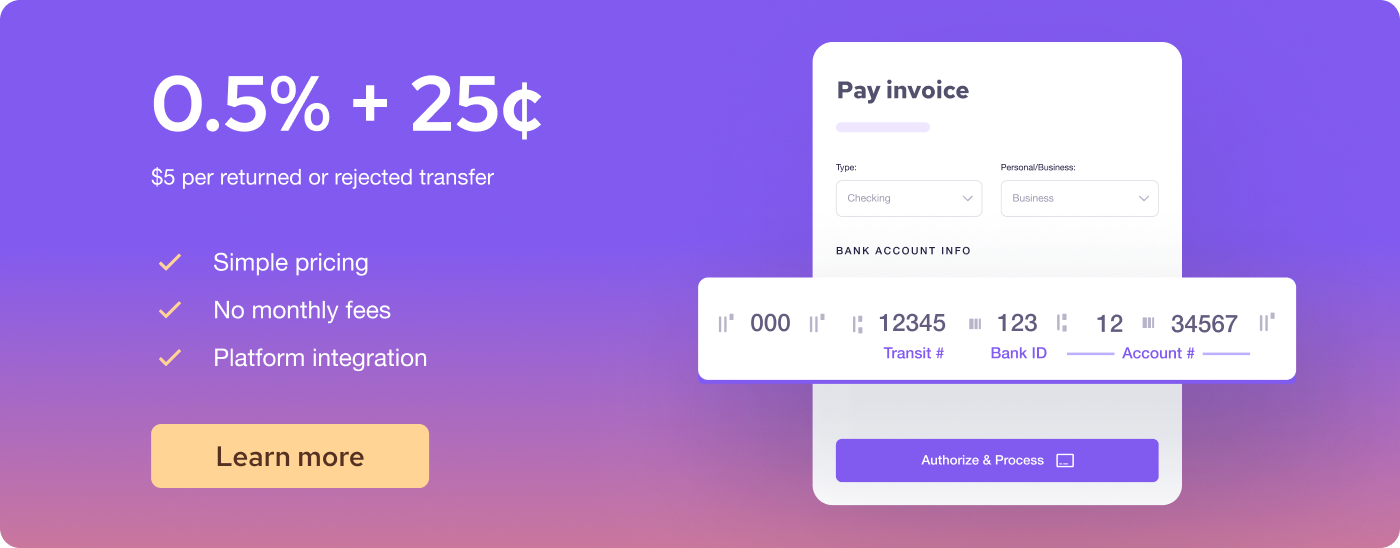
2. ACH / Bank transfers: Automated Clearing House (ACH) payments are electronic transfers made directly from your client’s bank account to yours.
| Pros | Cons | ||
|---|---|---|---|
| Business | Client | Business | Client |
| ACH transaction fees are typically much lower than credit card fees. | A secure and automated way to pay directly from their bank without sharing credit card details. | ACH payments can take 2–5 business days to process, with a risk of payment failure due to insufficient funds. | Some clients may be hesitant to provide bank account information. |
3. Checks: While once the standard, physical checks are becoming an outdated and inefficient method for handling recurring retainer payments.
| Pros | Cons | ||
|---|---|---|---|
| Business | Client | Business | Client |
| Low processing fees for large transactions, typically $10–$20 per check. | Some clients may feel more comfortable writing a check for big transactions. | Significant payment delays due to the manual deposit process and the high risk of checks being lost. | Clients must remember to manually write and mail the check each month, which is easy to forget. |
Key takeaways
Retainers are a great way to create predictable revenue for your business, but that predictability is only as strong as your payment system. Offering automated payments is the best way to lock in the predictability that makes retainers a high value tool.
By letting clients pay automatically with a credit card or direct bank payment, you create a smooth, hands-off system for everyone. You get paid on time, your clients get a convenient and secure experience, and you can finally stop chasing payments so you can focus on growing your business.
FAQ
Can customers get a refund on their retainer fee agreements?
The answer should be laid out in the retainer agreement signed by both parties. Generally, most retainer fees are non-refundable, but there are specific situations where a client may be entitled to get some or all of their money back.
Is a retainer fee different from a deposit payment?
Yes, a retainer fee is different from a deposit. While both are upfront payments, they serve very different purposes. An upfront retainer fee secures ongoing access to a service provider's time, whereas a deposit is typically a down payment on a specific, one-time project or product.
What type of businesses should use a retainer model?
Retainer accounts are a good fit for any business built on providing continuous service or work. If your clients need regular access to your skills, this payment structure provides stability for you and reliable support for them. Some of the most common businesses that use retainer services include legal representation services, consultants, marketing/creative agencies, freelancers, accountants, bookkeepers and PR firms.
Do I need to have an hourly rate as part of my retainer agreement?
While it's not strictly required for a retainer account, including one in your agreement is your best protection against "scope creep. If your retainer only covers three hours per month, state the rate for any excess amount of work. This will avoid any awkward conversations about charging more money for the project.
When do my fees become "earned retainer fees"?
The switch from unearned to earned happens as you fulfill your end of the deal. At the end of the retainer period (e.g., at the close of the month), you can officially recognize that payment as revenue. In your accounting software, you would make an entry to move the amount from the "unearned revenue" liability account to your "earned revenue" income account. This is crucial for keeping your financial reports accurate.
Why is a retainer payment considered an "unearned retainer fees" when I first receive it?
When a client pays you a retainer, they are pre-paying for work you haven't done yet. From an accounting perspective, that money isn't truly yours to count as income until you've completed the work for that period (usually the month). Until then, it's logged on your books as a liability named "unearned retainer fees".
Should my retainer agreement state that the fee is non-refundable?
Yes, in most cases, it is recommended to include a clause stating that retainer fees are non-refundable. A retainer isn't just a pre-payment for future hours worked. When a potential client hires you on retainer, you are reserving a portion of your availability for them, which may mean turning down other potential projects.
What's the difference between a retainer and a down payment?
The main difference is what you're paying for. A down payment is for a specific one-time project, while a retainer is for ongoing access to your services.
Related Articles
-

Collecting down payments ultimate guide for merchants
Robert Luong | August 21, 2025
-

Accept B2B payments: The ultimate guide
Robert Luong | March 3, 2025
-

How to collect an advance payment professionally?
Kaitie Weaver | February 21, 2025
-

Recurring payments 101: A small business guide
Jared Slemp | October 15, 2024
-

ACH Payment vs Wire: Which one is better?
Ryleigh Stangness | October 11, 2023
-

What is an ACH transfer and how much does it cost?
Danny Randell | August 13, 2021
