

-
Content
Last Updated on August 21, 2023 by Labib Ahmad
Understanding credit card pricing models
One of the most important considerations when selecting a payment processor for your business is which pricing structure they offer, or simply, how they structure their credit card processing fees.
It's important to understand what the different pricing structures are and how they will affect your monthly statement so you can select the billing arrangement that works best for your business. We will break down how the rates and fees are divided up so you can understand how much your credit card processor is making off each transaction. Taking the time to understand how your processor determines its rates can help you avoid sticker shock when you get your first statement.
At Helcim, we offer interchange plus pricing to all of our merchants and we, along with many others who are in the know, believe that this pricing structure is one of the best ways to avoid overpaying for credit card processing, so we'll start there.
The ultimate guide to accepting credit cards.
Discover essential knowledge and industry insights to increase your bottom line.
Credit card interchange plus pricing
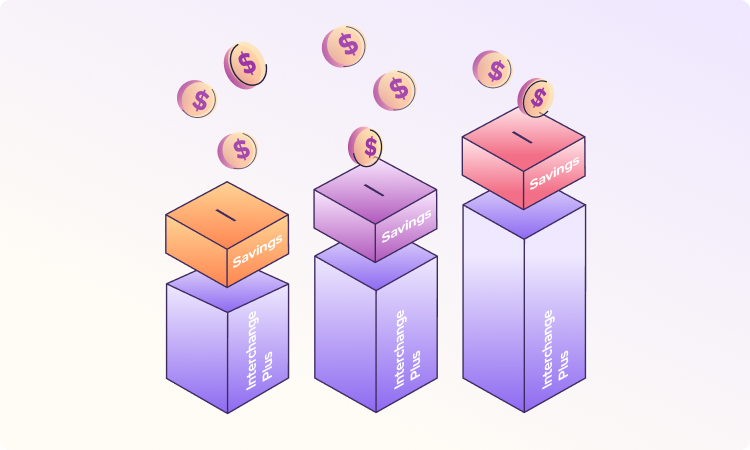
Often considered the most honest and affordable pricing model in the industry, interchange plus pricing creates a very transparent relationship between a merchant and their processor. With this pricing model, the processor margin will be a set percentage for each transaction, while the interchange fee, which fluctuates depending on which type of transaction is being processed, will dictate the final cost of a given transaction. This means that whenever you process a transaction that is eligible for a lower interchange fee, you will save money compared to if the transaction was completed using a flat rate.
While interchange plus pricing may seem more complicated to begin with because of the many different interchange rates out there, it can result in significant savings for your business.

Credit card flat rate pricing
If your payment processor charges a flat rate pricing structure, then they have taken the interchange fee, the card brand fee, and their margin fee to determine one single rate that will be applied to all the transactions that your business processes as a flat fee.
Because this is a flat pricing structure, you pay 2.9% on all of your transactions, even if the actual interchange rate varies between the different transactions. Depending on your business and the volume you are processing each month, this may mean that your business is paying more than it needs to for payment processing.
Many merchants are lured by the simple nature of flat-rate pricing and only having to be aware of a single fee for all transactions but may eventually realize their business has outgrown this model or could have been saving money with another processor all along. So, while this pricing model may seem simple or easier to understand, it's important to compare it with other pricing models to ensure you are, in fact, getting the best deal possible for your business.
Credit card tiered pricing
Tiered pricing usually consists of having a lower "qualified" rate for certain transactions and higher "mid" and "non-qualified" rates for others. This is the most common pricing method in the US. The common drawback is that merchants are enticed with a low "qualified" rate, which usually only applies to very select few types of cards, but nearly all transactions end up in the higher "mid" and "non-qualified" tiers.
If you're considering signing a contract with a merchant who offers tiered pricing, make sure you have a good grasp on which cards qualify for the lower rates and which cards your customers are currently using for transactions.
Credit card differential pricing
While less common in the US, Interchange Differential is common for Canadian processors.
Similar to tiered pricing, "qualified" and "non-qualified" fees are charged, but merchants are also charged "interchange differential fees" for credit cards, which further pads the processor's margins. This results in merchants paying multiple fees on the same transaction, essentially being double billed.
Understanding how each of these different pricing structures work will help you evaluate your payment processing options.
Save 25% credit card processing fees with Helcim
Credit card processing fees are a pain for most merchants. With Helcim's interchange-plus pricing, thousands of merchants have reduced their credit card processing fees by ~25%.
If you're ready to switch to Helcim but feel stuck with your current provider, we’ve got you covered. Our Merchant Buyout Program offers up to $500 in credits to cover your contract cancellation or equipment costs.
Besides, we'll guide you through the entire process—from handling cancellation paperwork to migrating your data to Helcim.
Break up with your current provider for better service and lower fees. Switch to Helcim with our Merchant Buyout Program.

Break up with bad rates.
Feeling stuck with your provider? We'll waive $500 of your processing fees when you switch to Helcim.
Related Articles
-
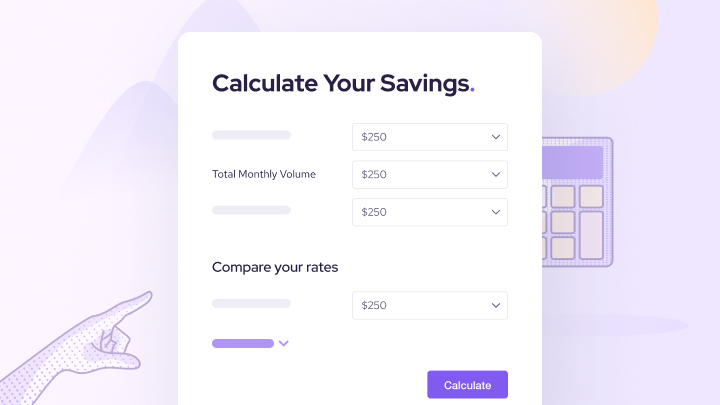
How to use the Helcim Rate Calculator
Ryleigh Stangness | May 19, 2023
-

Helcim vs. Square: An Honest Review & Comparison
Danny Randell | December 14, 2022
-
Stripe vs. Helcim- An Honest Review
Ryleigh Stangness | November 21, 2022
-

Interchange Plus vs Flat Rate Pricing: Which one is more affordable?
Danny Randell | September 13, 2022
-
Credit Card Processing Fees Ultimate Guide
Ryleigh Stangness | July 1, 2022
-
Interchange plus ultimate guide from A-Z
Jeff Merkel | June 14, 2022
